Education and social sciences is the largest collection in the directory: 24 verified titles from 15 countries, most carrying both Scopus and Web of Science labels. Fees start at $450 and the fastest reported first decision is 2 days.
Publishing in Education & Social Sciences journals: scope, route and the record you can verify
Written by the editorial desk · 24 verified titles · 15 countries · numbers refreshed with every record
What the Education & Social Sciences collection covers
This collection covers teaching and learning, educational policy, educational psychology, curriculum and assessment, and the sociology of education. The methods range from classroom trials to ethnography, and the strongest journals in the collection expect the method to be defended as carefully as the finding.
Two practical rules shape a submission here. Research with children needs parental consent and an ethics approval that names the school or setting; and pre-registration, open data and a reported effect size are increasingly expected even in qualitative work.
Teaching and learning —
Instruction, classroom interaction, motivation and learning outcomes.
Educational policy and leadership —
Governance, reform, school improvement and the politics of education.
Educational psychology —
Development, cognition, assessment and the psychology of the learner.
Curriculum and assessment —
Subject design, standards, testing and the validity of measurement.
Higher education —
Access, retention, internationalisation and the academic profession.
Social research methods —
Qualitative coding, mixed methods, sampling and the ethics of research with people.
The collection at a glance
These figures are read from the records on this page every time it loads, so they describe the collection you are looking at rather than last year’s brochure.
Live figures for this field collection.
Verified titles in this collection
24
Countries represented
15
Indexed in
Scopus: 17 · Web of Science: 13
Publication fee range
$450 – $4,400
Fastest reported acceptance
2 days
Quartile spread
Q1 · 4 Q2 · 4 Q3 · 6 Q4 · 2
The route from manuscript to indexed record
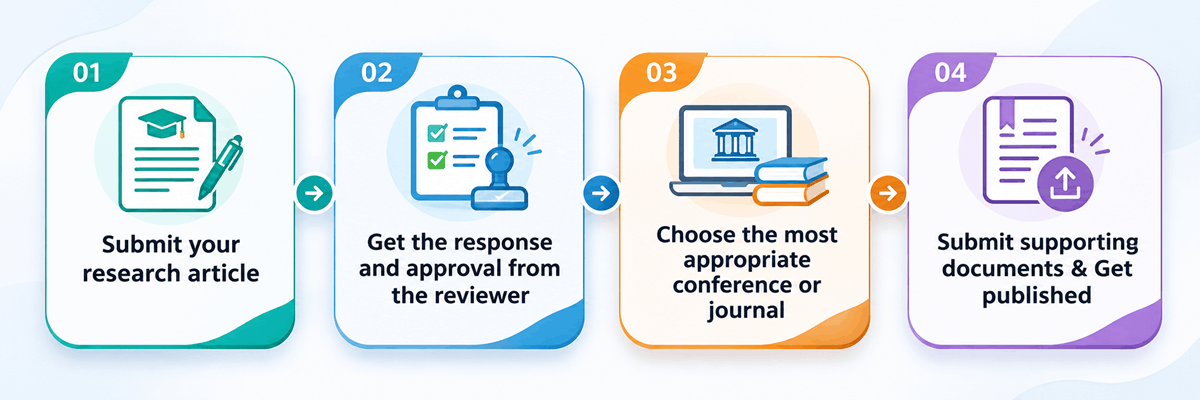
The four stages are the same, with one heavy addition at the front: education research carries the strictest consent requirements of any field in the directory, because so much of it involves children.
The four stages every submission passes through. In education consent is collected before the data, not before the deadline.
01
Submit your research article
The manuscript goes to the journal’s portal with ethics approval, parental consent (and pupil assent where required), the instruments and the anonymisation procedure. School or district permissions belong in the methods, not in a cover letter.
02
Get the response and approval from the reviewer
A first decision in eight to sixteen weeks is normal. Reviewers ask for a clearer sample, an effect size or a coding audit; answer each point with the analysis or the audit trail they asked for.
03
Choose the most appropriate conference or journal
If the first decision is a rejection, check whether the journal is policy-oriented or classroom-oriented. A study of instruction sent to a policy title is rejected on scope, and the same data fits a teaching journal unchanged.
04
Submit supporting documents and get published
After acceptance come the licence, the APC, proofs and the metadata. Check that the school or district is not identifiable in the final PDF, and that the affiliation and ORCID on the record are correct.
How to choose the right journal
Education journals divide by level, method and audience. Shortlist by the level you studied and the reader you want, then compare the indexing.
Level: early years, schooling, vocational or higher education — each has its own titles.
Method: trials, ethnography and policy analysis are reviewed by different pools.
Ethics: parental consent, pupil assent and school permissions must be documented.
Transparency: pre-registration, open data and a coding audit are increasingly expected.
Effect size and sample: reviewers in this collection ask for both, even in qualitative work.
Fee and timeline: reported first decisions start at 2 days, and APC or page charges vary widely.
Before you press submit: An education desk rejection is usually a consent or scope problem. A missing parental-consent statement stops a paper faster than a weak literature review.
Send the abstract and the database your committee accepts to [email protected]; you will get a shortlist with fees and review windows, in writing.
Why publish in Education & Social Sciences journals?
Consent-aware
Ethics approval, parental consent, pupil assent and school permissions are checked with you before submission.
Method-matched
A trial, an ethnography and a policy analysis are matched to titles that publish that design, not just that topic.
Both indexes, one record
Most titles here carry Scopus and Web of Science labels at once, with the quartile the journal reports.
No payment before acceptance
Nothing is charged until an acceptance letter exists; the journal’s APC and any handling fee are quoted in writing first.
Fast Publish Journal
Why authors use our desk
We keep 84 verified titles from 26 countries in the directory and handle the correspondence for you — from the first screening email to the decision letter.
Fast, traceable process
Screening starts the same business day and every stage has a date you can quote to your department.
Reputable partners only
We list a journal only after we can verify its ISSN and the indexing claim behind it; titles we cannot verify are disabled.
No payment before acceptance
Nothing is charged until an acceptance letter exists. The journal fee and any handling fee are quoted in writing first.
One named contact
You correspond with the editor handling your manuscript — not a ticket queue — and you keep the paper ID for every follow-up.
Coverage
Disciplines covered in this collection
Counts are taken from the 24 live records in this collection, so they move as the directory changes.
Medicine & Health
1 titles
Engineering & Technology
1 titles
Computer Science & AI
2 titles
Business, Management & Accounting
6 titles
Law & Political Science
3 titles
Education & Social Sciences
24 titles
Agriculture & Environmental Sciences
2 titles
Biology & Life Sciences
3 titles
Chemistry & Materials
1 titles
Arts & Humanities
3 titles
Multidisciplinary
3 titles
Process
How it works
01
Choose a journal
Filter the directory by indexing database, quartile, discipline or fee, then open the journal record to check scope, ISSN and timelines.
02
Send your manuscript
Upload a .doc, .docx or .pdf of up to 15 MB with your contact details. You receive a paper ID (FPJ-…) by email immediately.
03
Editorial screening
Our desk checks scope fit, formatting and ethics statements, then forwards the file to the journal editor of record.
04
Track to decision
You get the review timeline in writing. We follow up with the editorial office until an accept, revision or reject decision is issued.
Questions
Frequently asked questions
What consent is needed for research in schools?
Ethics approval, parental consent for minors, pupil assent where the journal requires it, and permission from the school or district. The approval must name the setting and the age group.
Do I need to pre-register an education study?
Not always, but several titles in this collection expect it for trials and quasi-experiments. Pre-registration and open data also strengthen a qualitative paper when the coding framework is deposited.
Are qualitative studies accepted?
Yes, at most titles in this collection, provided the sampling, coding and reflexivity are reported. A qualitative paper without an audit trail is the most common revision request.
How long does an education submission take?
Eight to sixteen weeks to a first decision is typical, and a revision adds a round. The acceptance time on each record is the journal’s own reported median.
What does publication cost in this collection?
Fees run from $450 to $4,400. Subscription titles may charge nothing to publish; open-access titles levy an APC, and waivers or institutional agreements are worth asking about before you submit.
What is the typical timeline?
Acceptance times reported by the journals here start at 2 days. Editorial screening on our side takes two business days, and the review window is confirmed in writing before submission.
Is acceptance guaranteed?
No — decisions belong to the journal editor and its reviewers. What we control is the accuracy of the journal match, the quality of the submission package and the speed of correspondence.
Publishing in Education & Social Sciences journals is a verifiable step: an ISSN, an indexing claim and a fee you can compare before you commit. 24 titles in this collection are open for submission today, and our desk handles the correspondence from screening to decision. Write to [email protected] with the abstract and we will return a shortlist with fees and timelines in writing.